July 28, 2026 · devlog
Every node's container view showed the wrong node
Rasputin’s observability stack has run cAdvisor on the control plane since
June — per-container CPU, memory, network, and disk, one slide-over drawer per
node. But cAdvisor ran only on the control plane, so every node’s Containers
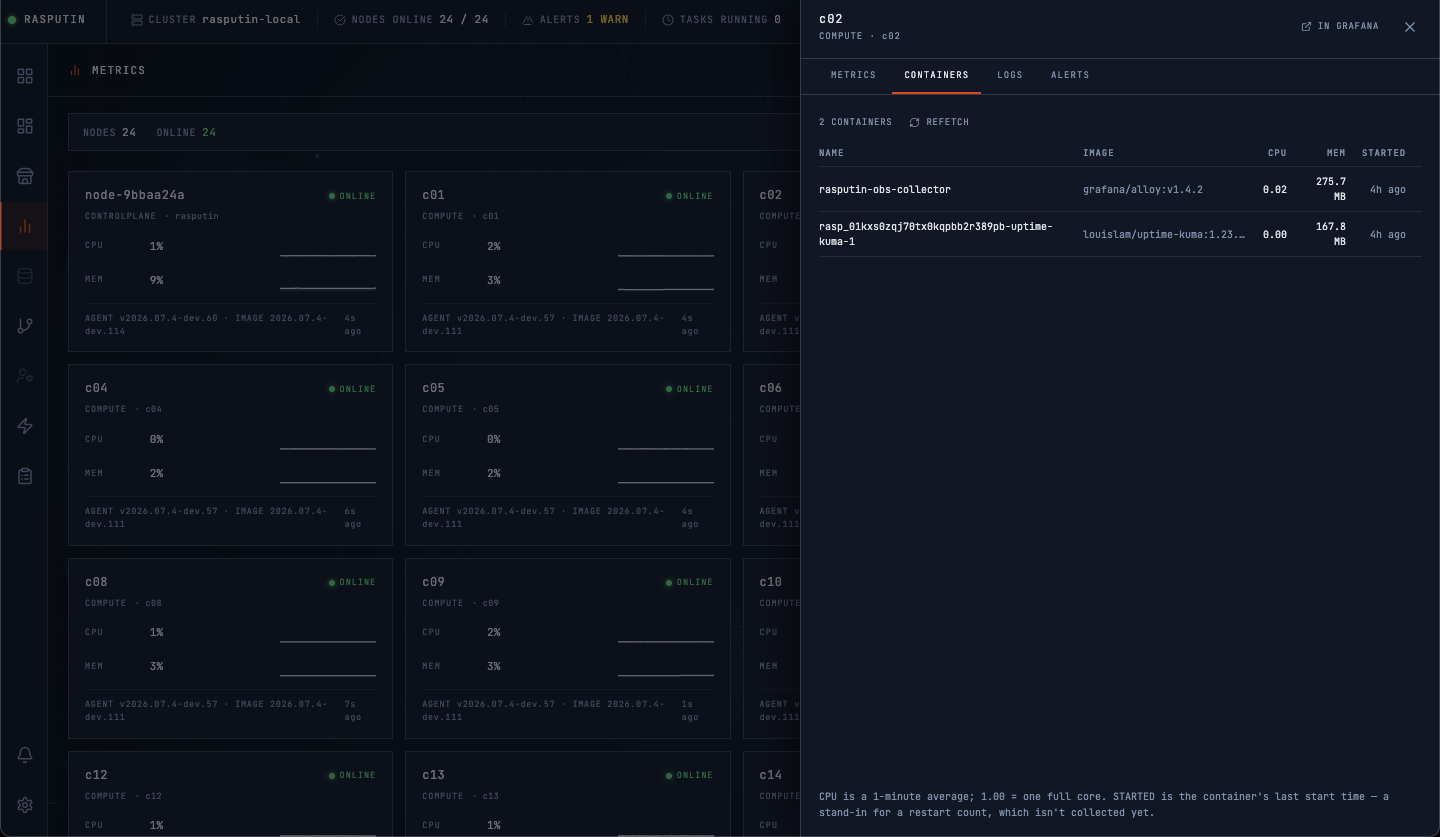
drawer showed the control plane’s containers. A container on compute node c02
was invisible in c02’s own view.
The constraint that shaped the fix:
- VictoriaMetrics is bound loopback-only (
127.0.0.1:8428) with no authentication. That is deliberate — an unauthenticated metrics store has no business on the LAN. - Compute nodes can’t reach loopback on the control plane, so per-node Alloy can’t just remote-write to VM. Something has to authenticate the write and keep VM where it is.
The decision (2026-07-17) — mTLS through the api, no open holes:
- Run Alloy + cAdvisor on each Docker-capable node, remote-writing through a
new mTLS-authenticated ingress on the api. The api is already the single
authenticated front door for the read side (
/api/obs/*, the Grafana proxy); this makes it the front door for metric ingress too. VM never leaves loopback. - Auth is mTLS off the per-installation mesh CA the cluster already has, which retires the whole bearer-token idea — nothing to mint, store, deliver, or revoke on a second path. The TLS handshake is the auth: verified once per connection, reused for the stream, which is the right shape for a persistent remote-write feed.
- The node’s client-leaf CN is its
node_id. The api reads that id off the verified client cert and reverse-proxies the raw remote-write body to the loopback VM at/api/v1/write?extra_label=node_id=<cn>. VM’sextra_labelstamps the id server-side and overrides anything the node sent — so the identity is cryptographic and server-authoritative, and the api never has to decode the Prometheus protobuf or pull in a new dependency.
The fix — the pieces (control-plane repo, dev builds):
- Client-auth leaf minter (
c879620): parameterize the mesh leaf minter’s EKU to stampclientAuth(it stampedserverAuthonly); re-mint on EKU drift. - mTLS ingress (
2066cd4): a dedicated:8443RequireAndVerifyClientCertlistener with mesh-CA client trust.POST /api/obs/ingestreadsnode_idfrom the cert CN, checks it against inventory (unknown node → 403), and proxies to loopback VM. A connection without a mesh-CA-signed client cert never finishes the handshake. - Collector compose builder (
a55c801):obs.BuildCollectorComposerenders a self-contained collector compose — Alloy’s config and all three PEM files (client leaf, key, mesh CA) carried inline as composeconfigscontent, so the agent writes no extra files.network_mode: host, because a bridged container can’t resolve the control plane’srasputin.localmDNS name — Docker’s DNS forwarder bypasses nss-mdns. Data-root pinned to the appliance’s/var/lib/rasputin/docker. - Reconcile + sagas (
2474092):obs.collectors.reconcileruns on the scheduler every 5 minutes — obs on → deploy a collector to every online compute/storage node; obs off → tear them down. Per-node deploy mints the leaf, renders the compose, and ships it over the existingdocker.deploycommand. No new agent command. The decision core is a pure function with fixed-clock tests over the whole matrix. - Containers filter (
2354a68):containers.goinjectsnode_id="<id>"into the cAdvisor PromQL so each drawer selects its own node. This also closes a latent bug — without the label, same-named containers across nodes (every node runs arasputin-obs-collector) collapse into one merged, wrong row.
What shipped: CP v2026.07.4 + OS 2026.07.4, both SKUs signed — pieces
1–5 plus the cAdvisor data-root fix (8e6d311) and the 24-node cap guard, cut
together. They went out on the dev channel first as CP dev.56 / OS dev.110
on 2026-07-18, which is what the bench run below used, and went stable
2026-07-19.
Bench validation (2026-07-18, the 24-node cluster):
- Upgraded the control plane only. obs was already enabled, so the collectors
auto-converged onto the fleet — no toggle, no per-node touch. The compute
nodes didn’t need updating; the collector rides the existing
docker.deploypath and their images already carry composev2.32.4. - Roughly 22 compute nodes pulled the Alloy image at once through one egress.
All but one landed on the first pass;
c13hit a transient Docker Hub TLS handshake timeout in the pull herd. It self-healed — a failed deploy cools down 30 minutes, then the next reconcile retries, uncontended by then. The image caches locally, so the 6-hour redeploys don’t re-pull; the herd is a one-time first-enable cost. uptime-kumaonc02finally showed up inc02’s own Containers drawer, next to itsrasputin-obs-collector. That single frame exercises the whole chain: reconcile deploy → collector compose up → client-leaf mint + mTLS handshake to:8443→ server-sidenode_idstamp → drawer filter. VM stayed on loopback the entire time.
Both tail items closed the same day. c13’s deploy self-healed on the next
reconcile, which is what the 30-minute cooldown is for. The disable→teardown
check found a real bug — the reconcile’s 6-hour freshness throttle keyed on the
last deploy and ignored a teardown since, so an obs off→on left collectors
stopped for up to six hours — fixed in 48d8248 and regression-tested.
Takeaway: an unauthenticated metrics store can still collect from the whole fleet — put an mTLS ingress in front of it and let the client cert’s CN be the node identity, so nothing has to open a port or trust a shared token.
Rasputin is an open-source (AGPL) homelab cluster system — a control plane, node OS, and firewall image that make a few Raspberry Pis or amd64 boxes behave like one appliance. It’s alpha, on GitHub, and I’m looking for a handful of design partners to run it and tell me what’s broken.
Want the next one in your inbox? Subscribe, or grab the RSS feed. Found something broken? We're recruiting design partners.